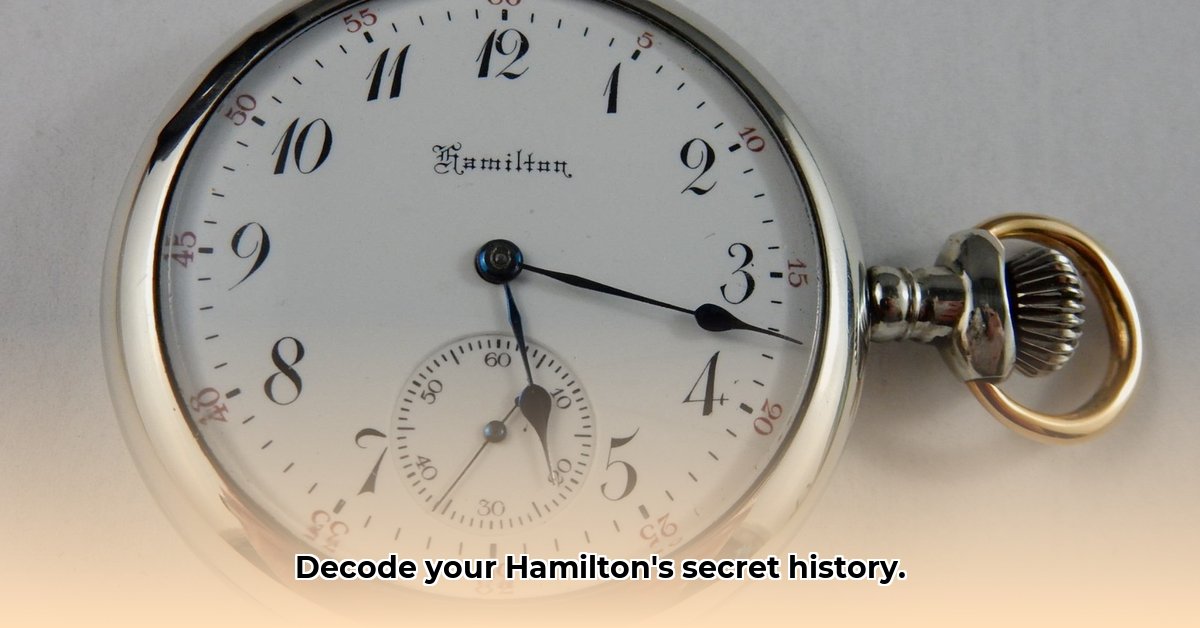
Hamilton Watch Serial Number Lookup: Uncovering Your Timepiece's Past
Have you ever wondered about the rich history embedded within your Hamilton watch? That seemingly insignificant serial number holds a wealth of information about its origin, age, and model. This comprehensive guide will empower you to decipher this cryptic code and uncover your timepiece's fascinating story, whether you're a seasoned collector or a curious newcomer to the world of Hamilton watches. We'll explore the secrets your serial number reveals and provide a step-by-step guide to using online resources to unlock your Hamilton's unique history.
Decoding the Serial Number: Unveiling Your Watch's Secrets
The serial number engraved on your Hamilton watch isn't random; it's a unique identifier that provides vital clues to its origins. This alphanumeric code acts as a historical fingerprint, revealing details about its manufacturing date, model, and potentially even its place of origin. But where exactly is this crucial information hidden?
Typically, the serial number is etched onto the watch's internal mechanism, known as the "movement" (the intricate system of gears and springs that powers the watch). This is often visible through the back of the watch case. Sometimes, you may find it stamped on the inside of the case itself. A little detective work might be required, but the effort is well worth the reward of uncovering the secrets of your Hamilton.
Online Resources: Your Digital Toolkit for Watch Research
While a single, comprehensive database encompassing all Hamilton serial numbers remains elusive, several valuable online resources can significantly aid your investigation. These act as crucial starting points in your quest to uncover your watch's story.
The National Association of Watch and Clock Collectors (NAWCC): This esteemed organization maintains a database containing valuable Hamilton watch information. While not exhaustive, their collection provides a significant resource for many Hamilton models.
Specialized Online Forums and Databases: Many dedicated online forums and specialized websites cater to specific types of watches, such as pocket watches. These can prove incredibly useful for locating information on rarer or older Hamilton models. Consider searching for forums related to vintage watches or Hamilton collectors' groups.
It's essential to remember that even with these resources, finding a complete history for every Hamilton watch isn't always possible. Record-keeping practices varied throughout Hamilton's history, leading to gaps in available data, particularly for older models.
Step-by-Step Guide: Using Online Databases for Serial Number Lookup
Let's navigate the process of using online resources to decode your Hamilton's history. Here's a clear, step-by-step guide:
Locate the Serial Number: Carefully examine your watch and find the serial number. It often appears small and might require close inspection. (Remember, it's usually on the movement, visible through the case back.)
Select the Appropriate Database: Choose a database best suited to your watch type. If unsure, try both the NAWCC and any specialized databases you locate.
Accurate Data Entry: Carefully type the serial number into the search bar. Accuracy is paramount! A single incorrect digit can render the results inaccurate or useless. Double-check your entry.
Interpret and Analyze the Results: The database may provide the model number, approximate manufacturing year, and other pertinent details. However, bear in mind that results may be partial or inconclusive. Treat the information as a strong indication rather than a definitive answer.
Beyond the Serial Number: Additional Clues to Your Watch’s Identity
While the serial number is pivotal, your Hamilton may hold other clues to its identity. These can add valuable context and further refine your understanding of its history.
Model Numbers: Usually found on the watch case or movement, these numbers identify the specific model.
Hallmarks: Tiny markings indicating the metal used in the watch construction (gold, silver, etc.) These offer insight into the era and quality of the watch.
Movement Specifications: Details engraved on the movement itself, outlining its design, components, and jewel count. These intricate details provide very specific information about the era and model.
Addressing Uncertainties and Further Investigation
Even with diligent research, complete historical details might remain elusive. Don't be discouraged! If you hit a dead end, consider these steps:
Consult a Watch Expert: A professional watch appraiser specializing in Hamilton watches can offer valuable insights and potentially verify your findings, adding expertise to your research.
Engage with Watch Enthusiast Communities: Connecting with experienced Hamilton collectors can unlock a wealth of knowledge and shared experiences, potentially revealing hidden information.
Uncovering your Hamilton's complete history is an engaging journey of discovery. It requires time, patience, and persistence. But the satisfaction of understanding the unique story of your timepiece makes the journey worthwhile.
How to Accurately Date a Hamilton Pocket Watch Using Serial Number Data
Three Key Takeaways:
- Online resources like PocketWatchDatabase.com and the NAWCC database offer assistance in dating Hamilton pocket watches via serial numbers, but their accuracy varies.
- Cross-referencing these databases enhances the chances of accurate dating.
- Always acknowledge the limitations of online databases; treat estimations with caution.
Utilizing Online Resources for Dating Your Hamilton Pocket Watch
Determining the precise manufacturing date of your Hamilton pocket watch can prove challenging. Two main online resources prove particularly valuable: PocketWatchDatabase.com and the NAWCC database. While both can be helpful, they have distinct characteristics.
PocketWatchDatabase.com: This user-contributed database contains a wealth of information. Its strength lies in breadth of data, but accuracy depends on the reliability of user input.
NAWCC Database: A more curated database, offering generally greater reliability. However, its coverage is likely less extensive than the user-submitted database.
To maximize dating accuracy, utilize both databases and compare the results. Remember that even with cross-referencing, complete certainty is difficult to achieve. Treat the dating estimations as guidelines rather than definitive answers.